
SUCCESS STORY
Cutting Methane Emissions Through Automation: From Prototype to Product with TwinCAT 3
HOERBIGER's Emissions Recovery System captures methane that would otherwise be vented into the atmosphere, cutting emissions and helping operators meet evolving environmental requirements — with the automation software behind it built by HEAP Engineering.
Challenge
Methane emissions from reciprocating compressors are among the most concentrated and addressable sources of greenhouse gas emissions in the natural gas value chain. HOERBIGER developed the Emissions Recovery System (ERS) to tackle this problem at the source — capturing methane from rod packing vents and other low-pressure emission points, then recompressing it back into the process. Instead of venting gas to the atmosphere, operators recover it, cutting methane and CO2eq emissions while increasing efficiency and meeting evolving environmental requirements.
The concept had already proven itself in various prototypes. Turning the prototype into a market-ready product presented a new challenge: HOERBIGER needed modern, scalable automation software that could run reliably in the field, integrate seamlessly with existing DCSs (Distributed Control Systems), and give operators an intuitive way to monitor and control the system — all while supporting future product generations.
Solution
HEAP Engineering partnered with HOERBIGER to design and build the automation software and control architecture on Beckhoff TwinCAT 3 PLC and TwinCAT TF2000 HMI. Our primary contribution was the design of the control software architecture and the implementation of the automation software.
Plants can operate several ERS units together, and the control system ensures they function as a single coordinated system with higher availability and throughput. Together with HOERBIGER, we designed a leader-follower architecture that automatically coordinates multiple compressors, balances load between them and allows new units to be added with minimal configuration effort.
Around that core, we built:
- Controller for the patented conical screw compressor
- DCS connectivity via Modbus TCP and RTU for seamless plant integration (extendable to any common fieldbus system)
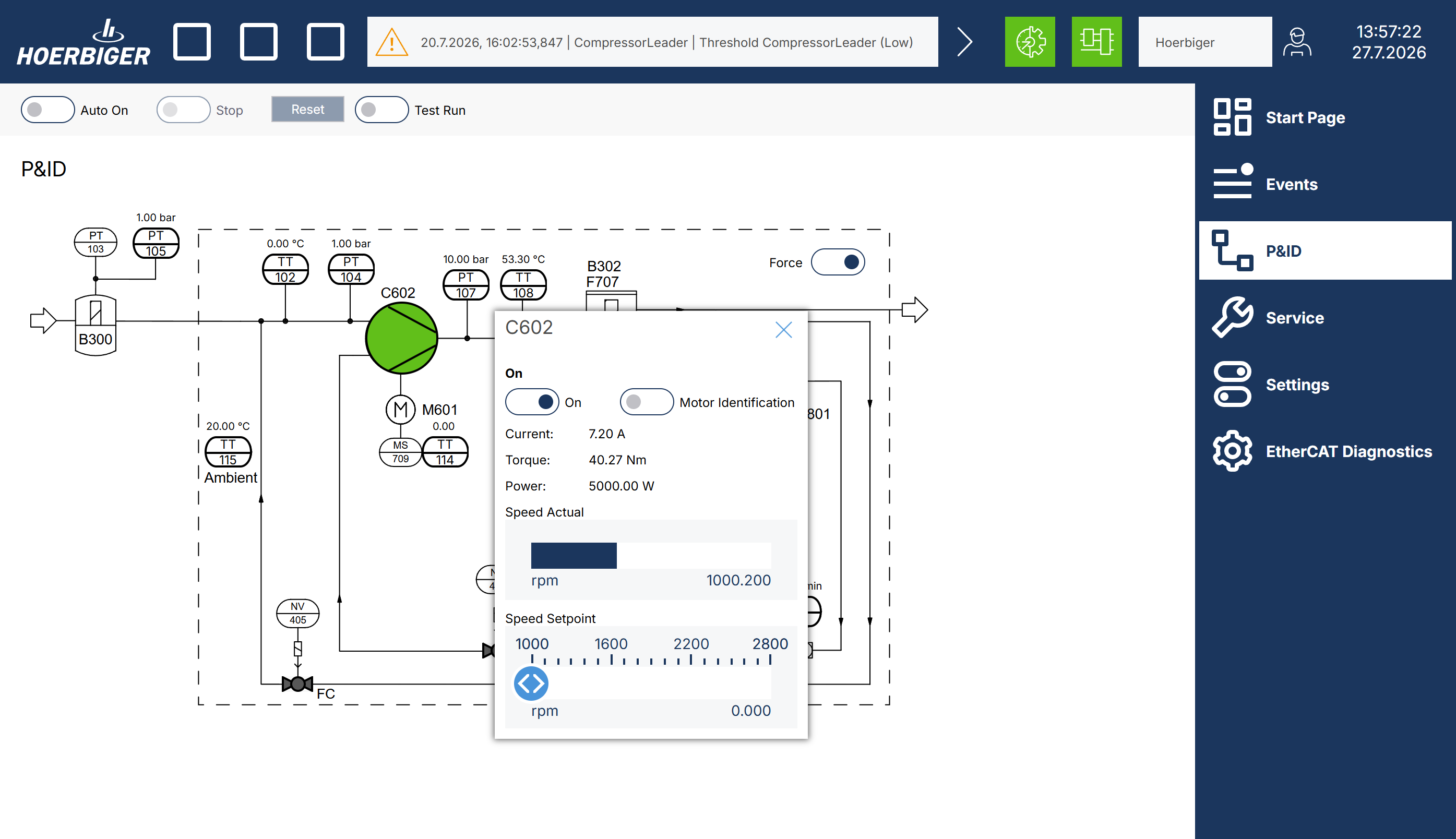
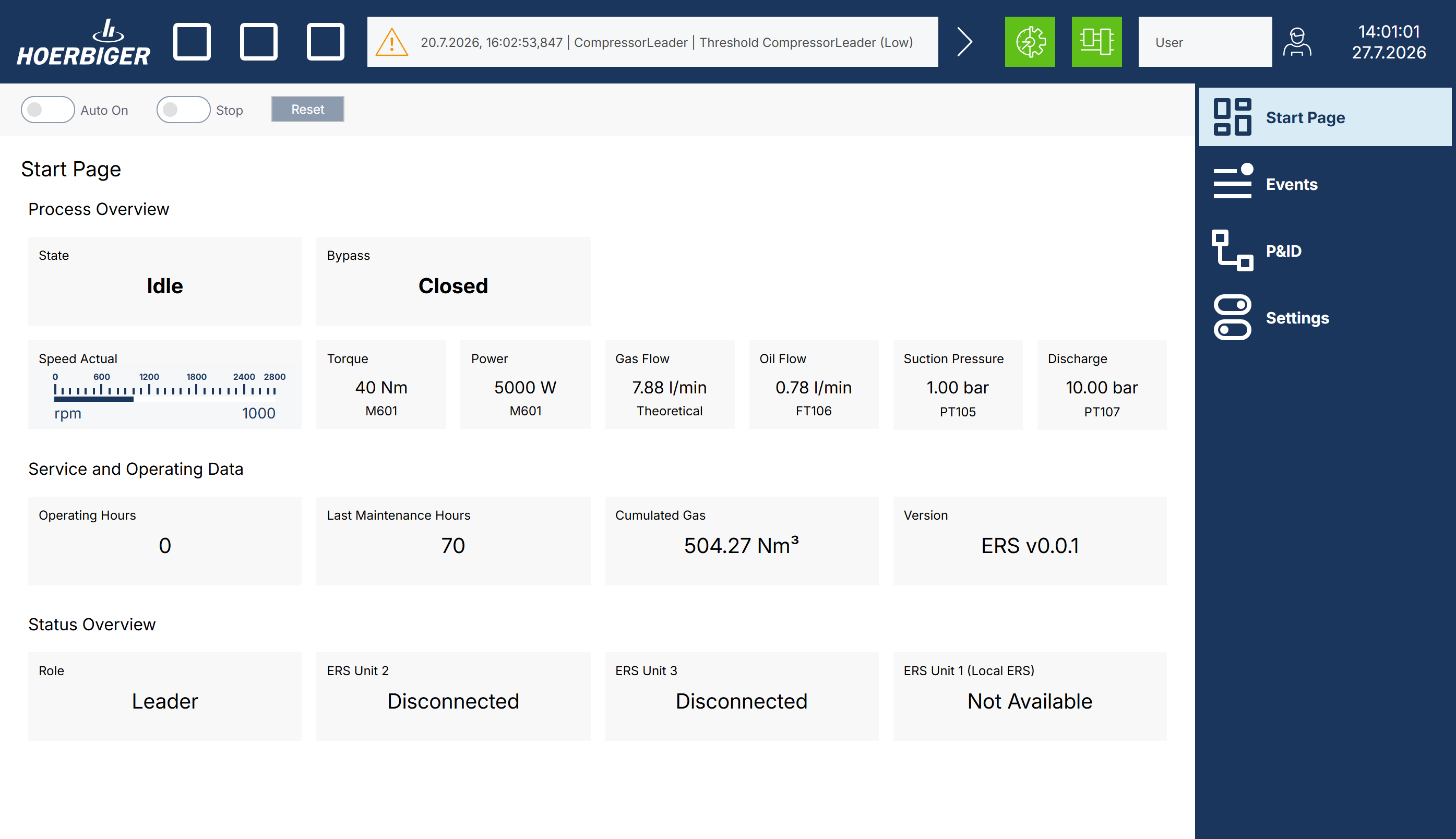
- A responsive, web-based user interface, fully aligned with HOERBIGER's corporate design
- Multi-unit and single-unit support from the same software base
- Multilingual operation for global deployment
To ensure high software quality, maintainability, and efficient commissioning, we backed the architecture with a full testing strategy: TwinCAT unit tests, integration tests (Python Behave), and virtual commissioning, enabling validation of critical functionality long before the first production units were commissioned in the field.
Results
The project transformed the ERS software into a production-ready platform for the ERS product line. The solution was delivered in May 2026 and is built on an architecture designed to support future generations of ERS products.
Key outcomes:
- Successful transition from prototype to product
- Reliable multi-compressor operation through a leader-follower architecture
- Seamless DCS integration via Modbus TCP/RTU
- Multilingual, dual-unit-system HMI ready for global rollout
- Significantly reduced commissioning risk and effort through virtual commissioning and automated testing
- A maintainable software architecture positioned to support HOERBIGER's future ERS product line
Technology Stack
Control System: Beckhoff CX5130 · TwinCAT 3 PLC
HMI: TwinCAT TF2000
Communication; Modbus TCP · Modbus RTU · EtherCAT
Software Quality: Python Behave · PLC Unit Tests · Virtual Commissioning